Internal Reference:
1302-006
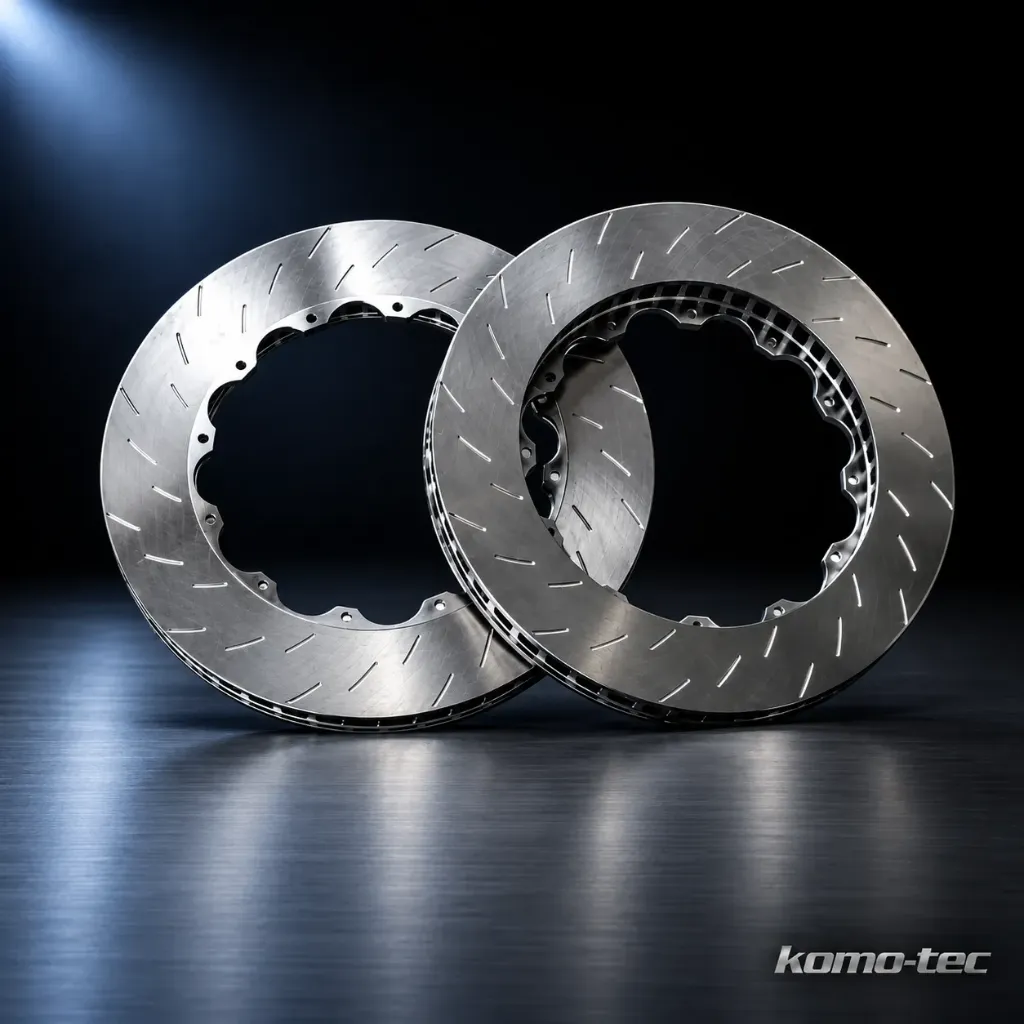
KOMO-TEC replacement friction ring set for KoBra 4 and KoBra 4-2
The KOMO-TEC KoBra brake systems use two-part brake discs, consisting of a lightweight aluminum pot and a replaceable friction ring. Once the friction rings have reached their wear limit, the complete brake discs do not need to be replaced.
This item includes the appropriate replacement friction rings for a complete axle including bobbin kit and the required mounting material. The existing aluminum pots are usually reused and are not included.
When do the friction rings need to be replaced?
Replacement is required when the wear limit of the friction rings has been reached. Indicators include:
The machined grooves are completely gone
Cracks extend to the outer edge of the friction ring
The friction ring has reached its permissible minimum thickness
There are damages, severe thermal deformations, or unusual wear patterns
The friction rings must be checked as part of regular maintenance. If any of the mentioned criteria are met, the brake disc must not be reused.
Reuse of the aluminum pots
In the two-part design, the existing aluminum pots can usually be reused. This means that during wear replacement, only the friction rings and the associated fastening elements need to be renewed.
Before reuse, the aluminum pots must be carefully checked for the following points:
Cracks and deformations
Damaged fastening holes
Worn-out receptacles
Corrosion and thermal damage
Runout and general condition
Aluminum pots that are no longer in perfect condition must not be reused and must be replaced separately.
Delivery as a complete axle set
The delivery is always made as a complete set for one axle.
The set includes:
1 × friction ring left
1 × friction ring right
1 × matching bobbin kit
Required fastening material
A single order for only the left or right side of the vehicle is not provided.
Machine run-in – Dyno-Bedded
The friction rings are delivered already "dyno-bedded". They are machine run-in on a test bench before delivery.
Through this controlled process, the friction rings already receive a prepared friction surface. After installation, the correct function of the braking system must still be checked and the specifications for the used brake pads must be observed.
Suitable for
KOMO-TEC KoBra 4 braking system
KOMO-TEC KoBra 4-2 braking system
KoBra systems with KOMO-TEC brake calipers
Front axle or rear axle, depending on the chosen version
Lotus Elise with four-cylinder engine
Lotus Exige with four-cylinder engine
Lotus 2-Eleven
The appropriate version must be selected when ordering based on vehicle model, axle, braking system, and existing disc size.
The friction rings are exclusively intended for the corresponding KOMO-TEC KoBra braking systems. They are not automatically compatible with standard brake discs or braking systems from other manufacturers.
Advantages
Suitable replacement friction rings for KoBra 4 and KoBra 4-2
Complete set for one axle
One left and one right friction ring
Bobbin kit included in the delivery
Required fastening material included
Existing aluminum pots can usually be reused
More cost-effective than replacing complete two-piece brake discs
Already machine run-in on the test bench
Available for front and rear axle versions
For Lotus Elise, Exige, and 2-Eleven with four-cylinder engine
Scope of delivery
2 × replacement friction ring, one piece left and one piece right
1 × complete bobbin kit
Required fastening material
Aluminum pots are not included. They are usually taken from the existing brake system, provided they are in technically perfect condition.
Important assembly note
The replacement of the friction rings involves safety-relevant components of the braking system and may only be carried out by a qualified specialist.
The aluminum pots must be completely cleaned and checked before assembly. Bobbins, fasteners, and friction rings must be assembled according to the technical assembly specifications.
After assembly, side play, clearance, correct float path, and all fastenings must be checked, among other things. Subsequently, a complete functional test of the braking system and a check of the used brake pads are required.