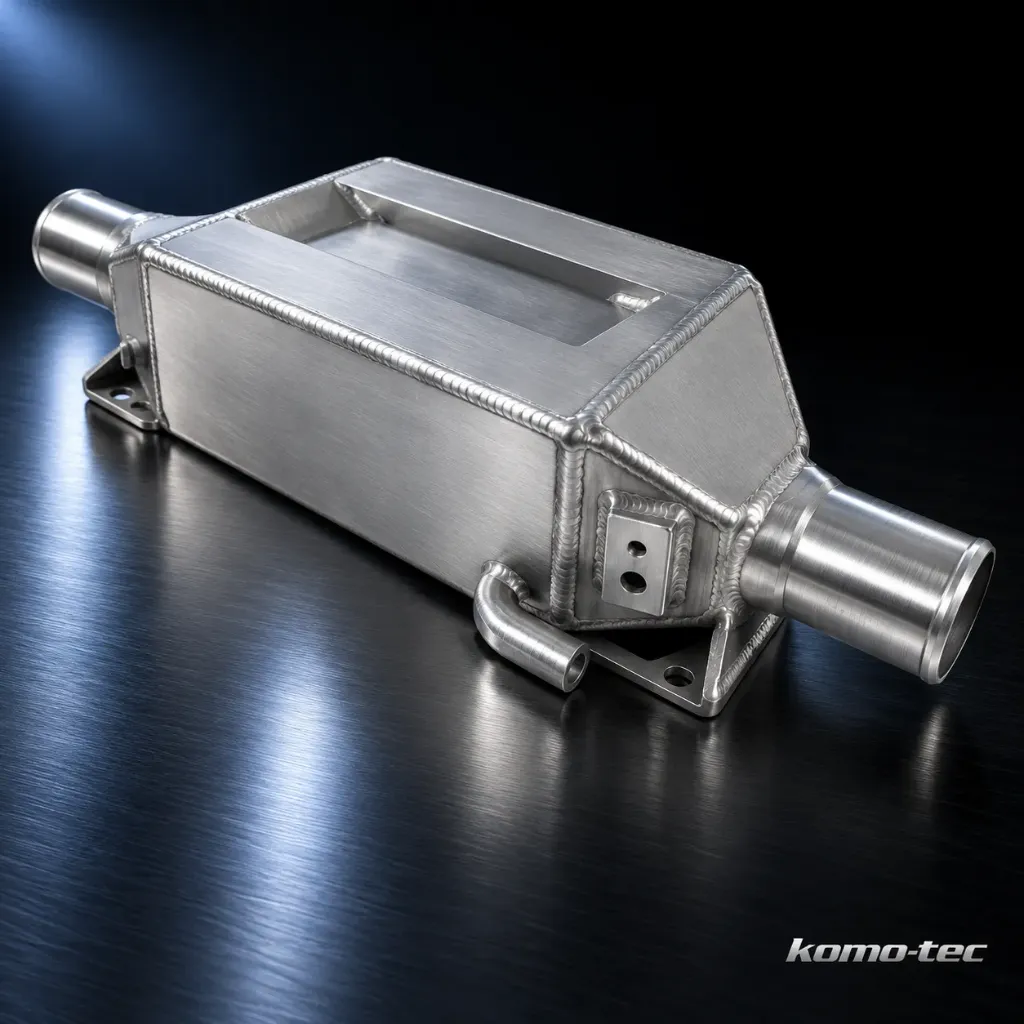
KOMO-TEC water-to-air intercooler upgrade for Lotus supercharger models
The KOMO-TEC water-to-air intercooler upgrade replaces the standard air-to-air intercooler system with a powerful, water-cooled charge cooler with its own cooling circuit.
The complete system includes the charge cooler, a high-performance heat exchanger at the front of the vehicle, an electric water pump, a coolant reservoir, the necessary water hoses, and all required small parts.
The upgrade is available either as a delivery kit or as a complete solution with professional installation in our facility.
The weak point of the standard system
One of the biggest limitations of charged Lotus models is the cooling of the intake air compressed by the compressor. Under high load, we have measured intake air temperatures of more than 80 °C with the standard air-to-air intercooler system.
As the charge air temperature rises, the air density decreases. At the same time, the tendency for knocking in the engine increases. The engine control must respond to this and adjust ignition timing and other map parameters to the increased temperatures.
Possible consequences are:
Decreasing performance under repeated full load
Less consistent power delivery
Increased thermal stress on the engine
Increasing tendency to knock
Retraction of the ignition timing by the engine control
Significantly lower power reserves at high outside temperatures
Faster thermal overload in track day and racing use
Conversion to water-to-air intercooling
During the conversion, the standard air-to-air intercooler is replaced by a water-cooled charge cooler. This transfers the heat of the compressed intake air to the coolant of a separate water circuit.
An electric water pump transports the heated coolant to the high-performance heat exchanger at the front of the vehicle. There, the absorbed heat is released to the ambient air. The cooled coolant then flows back to the charge cooler.
The additional coolant reservoir provides the necessary fluid volume and allows for proper filling and venting of the system.
High-performance heat exchanger at the front of the vehicle
The front-mounted heat exchanger utilizes direct airflow during operation. Its position allows the heat absorbed in the charge cooler to be effectively dissipated from the separate cooling circuit.
Compared to an air-to-air intercooler located in the engine compartment, the system is less dependent on the heat buildup occurring there. This supports lower and, above all, more consistent intake air temperatures.
Electric water pump
The electric water pump ensures continuous circulation of the coolant between the charge cooler, expansion tank, and front heat exchanger.
As a result, the cooling circuit operates independently of the engine cooling system and can be specifically designed to meet the requirements of intercooling.
Advantages of lower intake air temperatures
The more effective intercooling creates better thermal conditions for the entire engine operation.
The main advantages include:
Significantly improved intercooling
Reduced intake air temperatures
More consistent performance under high load
Lower tendency to knock
Reduced thermal stress on the engine
Higher power reserves at warm outside temperatures
More stable conditions during repeated accelerations
Especially beneficial for track days and racing use
Good foundation for further performance increases
More performance-oriented tuning of the engine control possible
Basis for optimized engine tuning
By significantly lowering and stabilizing the intake air temperature, the characteristic maps of the engine control unit can be tuned for better performance.
However, the water-to-air intercooling alone does not generate a defined increase in power. The actual result depends on engine condition, compressor ratio, boost pressure, fuel quality, intake and exhaust systems, as well as the engine software used.
A software or test bench calibration is not automatically included in the scope of delivery and must be ordered separately if needed.
Available Variants
Delivery kit without installation
The complete system is delivered as a component kit for installation by a qualified specialist.
Installation, electrical connection, filling, bleeding, and functional testing are not included in this variant.
Complete solution with installation
If you choose the variant with installation, we will take care of the complete installation in-house. This includes:
Removal of the standard air-to-air intercooler
Installation of the water-cooled charge cooler
Installation of the heat exchanger in the front of the vehicle
Installation of the electric water pump
Installation of the coolant reservoir
Routing of the water hoses
Electrical connection of the water pump
Filling and bleeding of the cooling circuit
Leak and functional testing
Any desired software adjustment or test bench calibration must be selected or agreed upon separately.
Scope of delivery
1 × water-cooled charge cooler
1 × high-performance heat exchanger for the vehicle front
1 × electric water pump
1 × coolant reservoir
Required water hoses
Mounting and connection materials
Required small materials
Coolant, installation, and engine tuning are only included if explicitly stated for the selected variant.
Suitable for
Selected Lotus supercharger models with standard air-to-air intercooler
Performance-enhanced Lotus supercharger models after technical inspection
Vehicles for sporty road use, track days, and motorsport
Exact compatibility must be checked before ordering based on vehicle model, year of manufacture, engine specification, supercharger version, and already installed components.
Important installation note
The installation involves modifications to the intake and cooling system and must only be carried out by a qualified specialist.
All hose connections must be installed without tension, securely fastened, and protected from heat and mechanical damage. After filling, the separate cooling circuit must be completely bled and checked for tightness, flow, and correct function of the electric water pump.
After installation, intake air temperatures and other relevant engine parameters must be checked. For performance-optimized vehicles, we recommend checking the engine tuning on the dynamometer.